Gold Price Analysis
Gold has shown remarkable resilience after rebounding above the $3,885 support zone, creating a potential breakout scenario for short-term traders. Despite recent volatility triggered by hawkish Fed comments and stronger U.S. economic data, the metal continues to act as a safe-haven amid geopolitical tensions. Investors should remain alert to key inflation releases, which could put pressure on prices, while identifying strategic opportunities for entry or exit. The ongoing surge above $4,000 highlights renewed bullish momentum and signals a lucrative opportunity for market participants. Reuters provides detailed updates on these market movements.
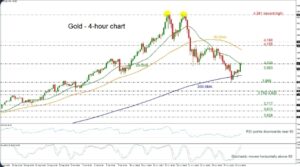
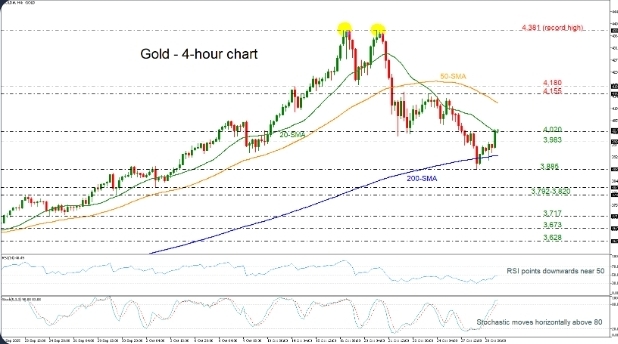
After a brief correction last week, triggered by stronger-than-expected U.S. employment data and hawkish Federal Reserve commentary, gold stabilized in the $3,880–$3,900 range. This recovery aligns with the 200-day SMA and reflects persistent demand from institutional investors, central banks, and safe-haven seekers. As of early November, gold trades near $4,015, awaiting cues from Thursday’s U.S. CPI release. Expectations are for a modest cooling from 3.7% to 3.5% year-on-year, which could drive gold toward the $4,120–$4,155 resistance band, while a surprise increase could pressure prices back toward support at $3,933. Investing.com charts provide traders with live technical indicators for these movements.
Technically, gold has reclaimed both the 50- and 200-period SMAs on the 4-hour chart, indicating that momentum buyers are gradually returning. The RSI is hovering around 55, leaving room for further upside without signaling overbought conditions, while the stochastic oscillator remains neutral near 50, suggesting potential for renewed directional moves. Immediate resistance levels are $4,120, $4,155, and $4,180, while support points sit at $3,933, $3,885, and $3,820. Trading volumes have slightly decreased, a typical sign of consolidation before a potential breakout.
Short-term traders may consider buy entries near $3,930–$3,950 with targets around $4,120–$4,155, while maintaining stop-losses below $3,900 to limit risk. A daily close above $4,120 would validate the bullish continuation, whereas failure to hold $4,000 could signal the start of another consolidation cycle. Monitoring macroeconomic catalysts is crucial, particularly during the November 7–15 period, which covers U.S. CPI, jobless claims, and comments from Fed Chair Powell.
Inside Eastleigh Chaos
On the fundamental side, gold continues to benefit from expectations of a data-dependent Federal Reserve. The Fed’s recent dovish signals suggest rate hikes may be paused if inflation continues to moderate, softening U.S. Treasury yields and indirectly supporting gold. Additionally, ongoing central bank purchases provide a strong floor for demand. According to the World Gold Council, more than 80 tonnes were purchased in October, primarily by Asian and Middle Eastern banks seeking to diversify reserves amid geopolitical uncertainty.
Geopolitical tensions further support gold’s appeal as a safe-haven asset. Recent unrest in the Middle East, supply chain disruptions, and global economic uncertainty continue to make bullion a preferred store of value. Investor sentiment remains cautious, with traders increasingly favoring gold to hedge against both inflationary pressures and potential market shocks.
Global demand trends also play a role in gold’s recovery. Physical demand from India and China remains robust, especially ahead of the festive and wedding seasons. Jewelry and investment purchases from these regions contribute to short-term support for the market, adding to the overall bullish picture. Meanwhile, ETF holdings continue to provide insights into institutional interest, showing gradual accumulation despite prior market corrections.
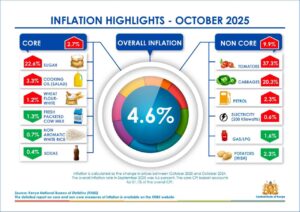
Kenya Inflation Data: October 2025 Review
Looking ahead, gold’s short-term outlook remains cautiously optimistic. If the U.S. CPI comes in softer than expected, prices could push toward the $4,155–$4,180 resistance range. Conversely, stronger-than-expected inflation may strengthen the dollar and pressure bullion back toward support zones at $3,933 and $3,885. Traders should employ disciplined risk management, maintaining positions above key support while remaining responsive to macroeconomic developments.
Overall, gold’s technical and fundamental narrative suggests a market that is cautiously bullish but sensitive to U.S. monetary policy, geopolitical risks, and investor sentiment. Daily monitoring and adaptive strategies remain essential for maximizing potential gains while mitigating risks in this dynamic environment. Reliable sources such as CNBC Commodities continue to provide updated market insights for investors seeking informed decision-making.
“Gold’s rebound above $4,000 signals renewed short-term bullish momentum, but inflation data will dictate whether the rally continues.”
This article was prepared by the Ramsey Focus Analysis Desk, based on verified market data, technical charts, and authoritative sources including Reuters, Investing.com, CNBC, and the World Gold Council.