
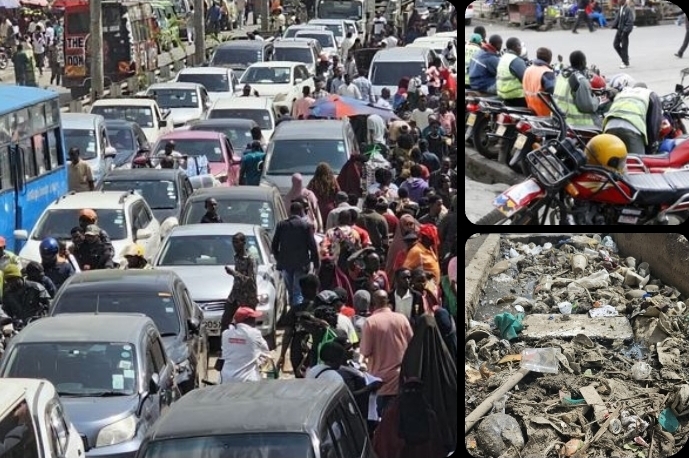
Every time I walk into Eastleigh, I feel as though I’m stepping into Nairobi’s paradox — a place bursting with opportunity but gasping for order. You don’t just visit Eastleigh; you survive it. The noise, the congestion, the suffocating air thick with exhaust fumes and dust — it feels like the neighborhood is breathing its last, even as its economy pumps millions of shillings every single day.
But Eastleigh’s problem isn’t just overcrowding. It’s structural failure — a deep, chronic urban disorder born from poor planning, weak enforcement, and the absence of foresight in managing what is now one of Nairobi’s busiest commercial zones.
The story begins with design — or rather, the lack of it. Eastleigh was never built to be a wholesale hub. Its narrow roads were designed in the 1940s for a residential neighborhood, not a bustling trade center serving Kenya, Somalia, Uganda, Tanzania, and South Sudan. Yet today, Eastleigh is the region’s informal logistics capital.
Every day, trucks loaded with bales of clothes, shoes, electronics, and textiles pour into its narrow streets. These trucks offload goods on the same lanes that vehicles are supposed to use, blocking entire sections of road for hours. There are no designated loading zones, no proper entry and exit channels.
Deliveries happen anywhere space allows — or rather, where traffic has already jammed. When one truck stops to offload, others line up behind it, tailing into roundabouts and feeder roads. It’s a logistical chokehold that cascades outward, spilling traffic into Juja Road, Muratina Street, and even into Pangani.
That’s where the mkokoteni come in — the handcarts that take over once the trucks offload. They supply the last mile: hauling bales from lorries to stalls, from shops to customers, from Eastleigh to nearby estates. They are the lifeblood of small traders, but they’re also the arteries of chaos.
Each mkokoteni competes for space with motorbikes, pedestrians, and cars. They move in clusters, shouting and pushing, often scratching vehicles and knocking people. A friend once joked that in Eastleigh, mkokoteni move faster than ambulances — and he wasn’t wrong.
Walking there is a daily negotiation with danger. I remember one afternoon when a mkokoteni brushed my arm, spinning me toward the road. A speeding motorbike grazed past, missing me by inches. Nobody stopped. Nobody even looked back. Everyone is in a hurry — to deliver, to sell, to survive.
Then there are the bodaboda — the kings of anarchy. They have turned every inch of tarmac, pavement, and even drainage edge into their runway. Their argument is simple: traffic doesn’t move, so they make their own lanes. But this improvisation fuels danger.
The constant honking, sudden brakes, and near misses are part of Eastleigh’s daily rhythm. It’s a rhythm that punishes both pedestrian and motorist. Add to that the broken drainage. Rainwater collects where drains are blocked by garbage — often dumped by traders with nowhere else to dispose waste.
What follows is predictable: flooded alleys, slippery pavements, foul smells. Wastewater mixes with spilt oil, forming a brown soup that you must wade through to reach a shop. When it rains, Eastleigh doesn’t just flood — it halts. Trucks stall. Bodabodas slip. Goods soak. Business slows.
Yet, beneath all this chaos, the economic machine still hums. Eastleigh remains one of Kenya’s biggest import and distribution hubs. It employs tens of thousands and supplies goods countrywide. But its unregulated growth has become its own trap. The same energy that built Eastleigh now threatens to choke it.
The county government occasionally swings into action — sweeping hawkers off pavements, clearing garbage, or issuing warnings. But these interventions are short-lived because they treat symptoms, not causes. The real disease is poor urban planning and absence of structured logistics.
Eastleigh is operating like a megamarket inside residential streets, without service lanes, truck terminals, or pedestrian infrastructure. You can’t enforce order in a place that was never built to hold it. Every major wholesale hub in a serious city — think Dubai’s Deira or Istanbul’s Laleli — has structured delivery systems.
City engineers say that Eastleigh’s original road network was meant for about 3,000 vehicles a day. Today it handles nearly 25,000, not counting handcarts and motorbikes. That mismatch alone explains why traffic crawls at walking speed. Add double parking, street vending, and lack of drainage — and the area collapses under its own weight.
But what makes it worse is the absence of planning for entry and exit routes. Eastleigh’s main arteries — First Avenue, Second Avenue, General Waruinge Street — are all single-lane corridors with minimal turn-offs. Trucks enter through the same narrow routes that shoppers use.
Once inside, there’s nowhere to turn, nowhere to park, nowhere to breathe. The congestion you see isn’t random — it’s structural gridlock. If Nairobi County is serious about restoring sanity, the solution must be surgical, not cosmetic. It begins with reorganizing logistics.
“If Nairobi can’t fix Eastleigh, what hope is there for the rest of the city?”
Create a truck staging area outside Eastleigh — near Pumwani or along the Outer Ring corridor — where goods can be offloaded into smaller, regulated delivery vehicles during off-peak hours. Introduce time-based deliveries — nights or early mornings — to reduce daytime truck blockages.
Designate mkokoteni zones, license them, and train operators. Build pedestrian walkways, mark lanes for bodaboda, and enforce them without compromise. Drainage and waste systems need a complete redesign — not patchwork fixes.
Traders must be made part of the solution, not just blamed. Their associations can co-manage sanitation, as seen in Gikomba’s pilot clean-up model. Eastleigh thrives because of its people; it can be fixed by them too, if guided by smart policy.
But none of this will happen unless leadership stops seeing Eastleigh as a nuisance and starts treating it as a national economic asset in crisis. The area generates millions in taxes and trade value. It deserves planned infrastructure, not neglect.
Every city has a place that defines its energy — its pulse. Eastleigh is that place for Nairobi. But right now, that pulse is irregular, choking under the pressure of neglect. You don’t need to be an expert to see it — you just need to walk those streets.
The honking, the pushing, the heat, the stench — they all scream one message: this city has lost control of one of its most vital organs. The government must intervene — not with force, but with intelligence. Not by arresting traders, but by building systems that work.
Because if Eastleigh collapses, part of Nairobi’s economy goes with it. And if Nairobi can’t fix Eastleigh, what hope is there for the rest of the city?
This article was prepared by the Ramsey Focus Analysis Desk, based on verified reports, independent analysis, and insights to ensure balanced coverage.



















7 Responses