Oburu Oginga Addresses ODM Internal Divisions and Cooperation with President Ruto
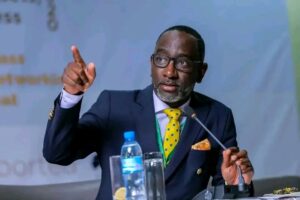
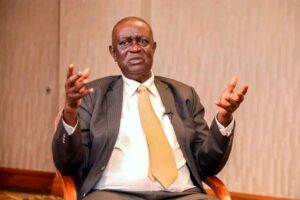
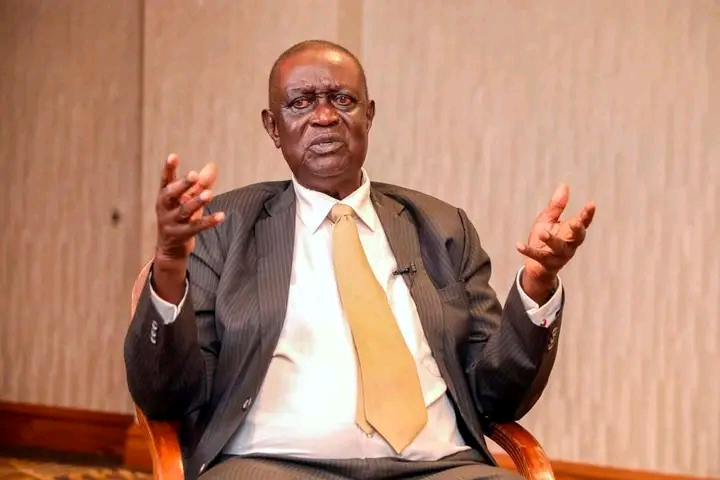
Oburu Oginga has once again ignited political conversation in Kenya, not just for what he said, but for what his words reveal about the future of the ODM Party and the country’s post-Raila political landscape. His latest interview offers rare insight into the soul of a party caught between loyalty, legacy, and renewal. Beneath the nostalgia and grief, Oburu’s statements reflect a deeper struggle to define what ODM means in a Kenya that is already moving beyond the era of Raila Odinga. Read more on Reuters Africa Politics.
In the interview, Oburu Oginga’s endorsement of Edwin Sifuna as the official spokesperson of the ODM Party was a deliberate signal of control. It was not merely about communication hierarchy but about restoring order in a political movement that has lately looked fractured and uncertain. His insistence that figures like John Mbadi and Opiyo Wandayi, who now work closely with government, should resign if they want to maintain ODM loyalty, underscores the ideological fault lines tearing through the party. It is a statement of intent: ODM must either reclaim its opposition spirit or risk dissolving into political complacency.
But the tension goes beyond individuals. ODM’s struggle today reflects the vacuum left by Raila Odinga’s towering influence. Without his unifying charisma, competing factions have emerged—some embracing government collaboration for survival, others pushing for a radical return to opposition politics. Oburu Oginga’s effort to reassert discipline is therefore more than sentimental. It’s an attempt to rescue ODM from an identity crisis that threatens to dismantle years of political investment. In his tone lies both the burden of leadership and the fear of irrelevance.
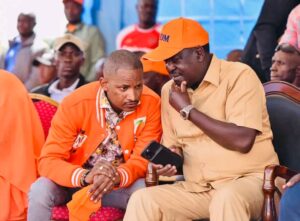
One of the most striking elements in Oburu’s remarks was his embrace of youthful figures like Babu Owino. By publicly defending Babu and expressing a desire to make him “comfortable” within ODM, Oburu positioned himself as a bridge between generations. He understands that the party’s survival depends on harnessing the energy and ambitions of younger leaders who command online influence and urban appeal. Yet, his subtle caution that Babu cannot be governor of Nairobi by “hiring youth to shout his name in Bondo” also reveals Oburu’s awareness of the dangers of populist politics detached from institutional grounding.
This balance—between inviting youth and enforcing discipline—captures ODM’s biggest dilemma. The party must rejuvenate without losing ideological focus. It must welcome new voices while guarding against chaos. Oburu Oginga’s message therefore resonates beyond Babu Owino; it speaks to a generation of restless political aspirants eager to inherit ODM’s mantle but unsure what values they are inheriting. The generational shift he advocates is not merely biological but philosophical—a struggle between populism and principle, between digital excitement and structured governance. More insights on Bloomberg Africa Politics.
Oburu’s statement that ODM is not a family inheritance but a political institution was a direct response to critics who frame ODM as a dynastic project. He dismantled that perception by noting that even Jaramogi Oginga Odinga’s original party now belongs to Moses Wetang’ula. It was a symbolic renunciation of ownership, signaling that ODM must outgrow personal identities and transform into a sustainable political ideology. In Kenya’s political context, this is both revolutionary and risky. Many parties are personality-driven, surviving as long as their founders are active. Oburu Oginga’s argument challenges that model and calls for a new political architecture grounded in continuity, not charisma.
Gold Price Analysis
Equally revealing was his justification for ODM’s decision to cooperate with the government after the protests. He argued that Kenya was on the brink of losing its democratic gains and risked sliding into a military coup. It was a startling admission that underscores how fragile Kenya’s democracy remains beneath the surface of its constitutional order. By crediting this cooperation for averting potential chaos, Oburu reframed ODM’s move as an act of national responsibility rather than capitulation. His reasoning reflects a pragmatic, survivalist approach that places national stability above short-term political advantage.
In a country where opposition politics often thrive on defiance, such pragmatism is bound to attract criticism. Many ODM loyalists see collaboration with President Ruto’s government as betrayal. Yet, viewed through Oburu Oginga’s lens, it was a necessary pause—a strategic recalibration meant to preserve the party and the country from deeper turmoil. His warning about the risk of a military coup, though unsettling, hints at intelligence and insight that the public rarely sees. It suggests that Kenya’s political equilibrium is far more delicate than it appears, and ODM’s leadership may have chosen compromise over collapse. Additional reporting available at IMF News.
The emotional segments of the interview—especially Oburu’s reflections on Raila Odinga’s death—added depth to the political analysis. He spoke with rare vulnerability about the bond he shared with his brother, describing him as “more than a brother” and recalling how they grew up almost like twins. His acknowledgment of President Ruto’s role in facilitating Raila’s evacuation to India was unexpected and profound. In an era of fierce political rivalry, such gratitude humanized the discourse. It was a reminder that beneath Kenya’s political theatre lies a shared sense of humanity that transcends ideology.
However, Oburu’s tone of reconciliation may also reshape future alliances. His public appreciation for President Ruto could soften relations between ODM and the Kenya Kwanza administration, potentially opening pathways for political realignment ahead of the next general election. Whether this leads to a strategic merger, a coalition, or a new opposition front remains uncertain. But what is clear is that Oburu Oginga has positioned himself as a statesman navigating a fragile transition between Raila’s legacy and the next generation of leadership.
BTCUSD Analysis
Nationally, the implications are far-reaching. ODM’s internal reconfiguration will inevitably affect Kenya’s wider political balance. The party’s traditional role as the opposition anchor has defined Kenya’s democratic culture for decades. Should it fragment, the space could be filled by new movements or regional coalitions, altering the power dynamics that have long defined national politics. In that sense, Oburu’s words are not just reflections—they are warnings. He is urging ODM to evolve or risk extinction in a political environment that rewards adaptability over nostalgia.
Kenya now stands at an inflection point. The passing of Raila Odinga marks the end of an era, but also the beginning of a new ideological contest. Will ODM reinvent itself into a structured, national institution led by a new generation of thinkers and reformers? Or will it disintegrate under the weight of internal contradictions and personal rivalries? Oburu Oginga’s voice, steeped in experience and emotion, may not provide all the answers, but it offers the clearest roadmap yet—a call to preserve democracy through maturity, inclusivity, and reflection.
The post-Raila era is already redefining Kenya’s politics. From youthful ambition to elder wisdom, from opposition fire to pragmatic diplomacy, the struggle for ODM’s soul continues. Oburu Oginga may not have sought to dominate headlines, but his words have done exactly that—forcing the nation to confront uncomfortable truths about leadership, loyalty, and the price of political evolution.
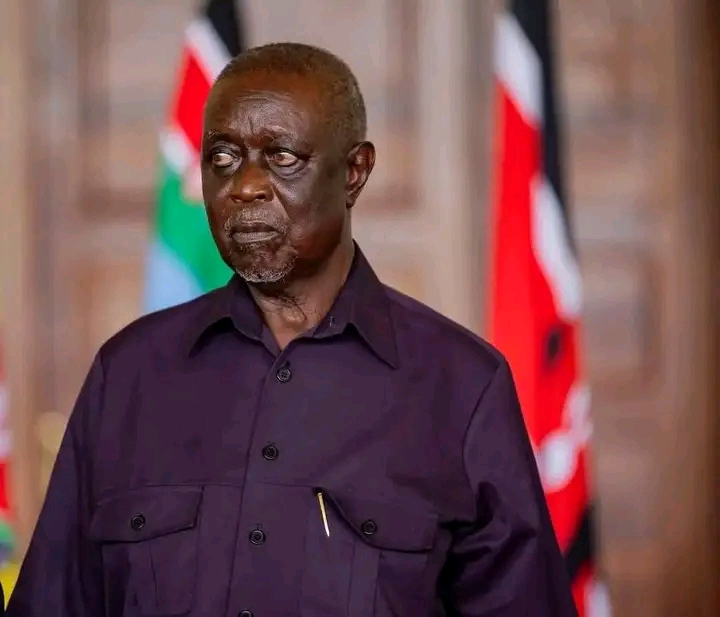
“ODM must either reclaim its opposition spirit or risk dissolving into political complacency.”
This article was prepared by the Ramsey Focus Analysis Desk, based on verified reports, independent analysis, and insights to ensure balanced coverage.