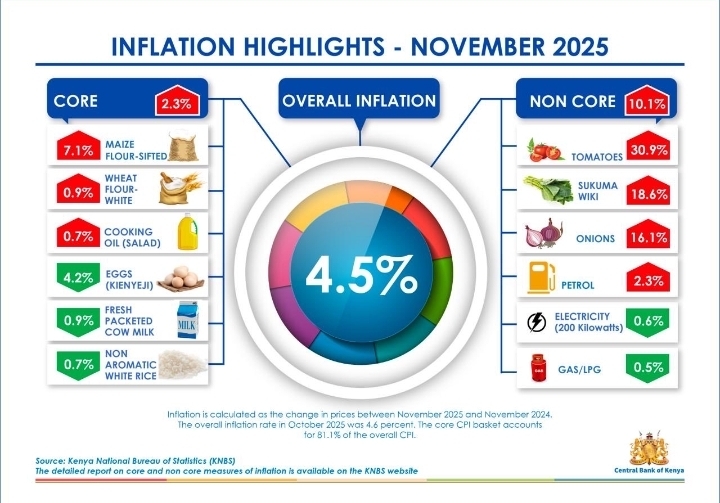
Kenya’s inflation highlights for November 2025. Source: KNBS.
Kenya’s Inflation Eases to 4.5% in November 2025 as World Bank Adjust GDP Growth Rate to 4.9%
Kenya’s inflation rate eased to 4.5% in November 2025, down slightly from 4.6% in October, according to the latest data released by the Kenya National Bureau of Statistics.
This keeps inflation comfortably within the Central Bank of Kenya’s target range of 2.5%–7.5%, indicating continued macroeconomic steadiness. However, the slowdown is overshadowed by sharp increases in prices of essential food items that continue to tighten household budgets.
The report shows core inflation standing at 2.3%, reflecting stable pricing in sectors like household goods, housing, and transport services.
In contrast, non-core inflation surged to 10.1%, driven overwhelmingly by steep rises in fresh produce and selected fuel-related items.
Economists say this widening gap underscores Kenya’s susceptibility to climate disruptions and supply chain inefficiencies that frequently destabilize food markets.
Tomatoes recorded the highest jump at 30.9%, driven by reduced harvests, increased transportation costs, and delayed market deliveries.
Sukuma wiki rose by 18.6%, while onions increased by 16.1%, a combination that has placed significant pressure on daily food expenditure.
These three items are consumed widely across Kenyan households, meaning their inflationary effects are felt almost universally.
Fuel prices contributed mildly to inflation, with petrol increasing by 2.3% due to global oil market fluctuations and currency pressures.
Electricity prices dropped by 0.6%, while LPG declined by 0.5%, offering some relief to urban families.
However, transport providers say higher fuel costs are already feeding into food distribution expenses, worsening price instability for vegetables.
Within core food categories, maize flour (sifted) climbed by 7.1%, reflecting inadequate harvests in several producing counties.
Wheat flour rose by 0.9%, while cooking oil increased by 0.7%, influenced partly by global commodity price trends.
A recent CBK technical note suggested that international supply dynamics could continue shaping domestic food inflation in the months ahead.
Some items, however, saw reductions. Kienyeji eggs dropped by 4.2% due to improved poultry supply, while fresh packed cow milk decreased by 0.9% following favourable dairy yields earlier in the year.
Non-aromatic white rice also dipped by 0.7%, supported by steady import levels and increased local farming efforts.
The inflation report comes at a time when the World Bank has revised Kenya’s economic outlook upward, projecting a stronger 4.9% GDP growth in 2025.
This revision is based on improved investor confidence, recovering agricultural output, and stabilizing global economic conditions.
By 2026, overall economic growth is expected to rebound to around 5%, signalling renewed momentum after several years of climatic and fiscal shocks.
The World Bank further projects that the construction sector will grow to contribute 6.29% of Kenya’s GDP by 2028, driven by urban expansion, housing demand, and public infrastructure investment.
Analysts argue that such medium-term projections offer optimism that Kenya’s economy is gradually transitioning toward stronger and more sustainable growth pathways.
Even with this positive outlook, the current inflation pressures are shaping the lived realities of households.
Market vendors say consumers are buying smaller quantities of tomatoes and onions, while sukuma wiki purchases have declined sharply.
Households are adjusting meal plans, opting for cheaper vegetables, or revisiting traditional low-cost food alternatives.
Transporters report that poor road conditions in some counties have worsened supply delays, causing spoilage and further reducing the availability of fresh produce in urban markets.
Unless addressed, these logistical barriers may continue pushing food prices upward as the festive season approaches, when demand traditionally rises.
Economists note that Kenya’s inflation trajectory will depend heavily on rainfall performance, agricultural productivity, and global energy market stability.
Investments in irrigation, climate-resilient farming, and improved storage systems are increasingly critical to shielding the economy from recurrent food price shocks.
The CBK is expected to maintain a cautious monetary policy stance, balancing the need to contain inflation with the importance of supporting economic recovery.
With food prices still volatile, policymakers will likely focus on supply-side interventions rather than aggressive interest rate adjustments.

“Kenya’s inflation may be easing overall, but the steep rise in essential food items continues to strain household budgets as the country awaits a fuller economic rebound.”
This article was prepared by the Ramsey Focus Analysis Desk, based on verified reports, independent analysis, and insights to ensure balanced coverage.