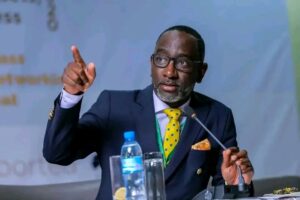
Prof. Njuguna Ndung’u: The Economist Who Helped Transform Kenya’s Financial System
Professor Njuguna Ndung’u is one of Kenya’s most influential economists, academics and public-policy leaders. His career has taken him through university teaching, economic research, central banking and national financial management.
He is best known for serving as Governor of the Central Bank of Kenya during a period when the country emerged as a global leader in mobile money and financial inclusion. His leadership helped create an environment in which digital financial services could develop while remaining under regulatory supervision.
Prof. Ndung’u’s journey demonstrates how academic knowledge can be transformed into practical policies that affect millions of people. His work has influenced monetary policy, financial-sector regulation, digital finance and economic development across Kenya and the wider African continent.
Early Life and Academic Background
Prof. Njuguna Ndung’u was born in 1960 in Kandara, Murang’a County. His interest in economics eventually led him to pursue extensive academic training in economic theory, policy and quantitative analysis.
He earned his bachelor’s and master’s degrees in economics from the University of Nairobi. He later obtained a doctorate in economics from the University of Gothenburg in Sweden.
His education gave him a strong foundation in macroeconomics, econometrics, monetary policy and development economics. These areas would later become central to his work as a lecturer, researcher and senior public official.
From University Teaching to Economic Research
Before taking up senior public appointments, Prof. Ndung’u taught advanced economic theory and econometrics at the University of Nairobi. His academic career enabled him to train students while contributing to debates about Kenya’s economic development.
He also worked at the Kenya Institute for Public Policy Research and Analysis as a principal researcher and head of its Macroeconomic and Economic Modelling Division. The position placed him close to national discussions about inflation, public spending, employment and economic growth.
Prof. Ndung’u additionally served as a regional programme specialist at the International Development Research Centre and as Director of Training at the African Economic Research Consortium. These roles allowed him to connect academic research with practical policymaking across Africa.
Appointment as Central Bank Governor
Prof. Ndung’u became the eighth Governor of the Central Bank of Kenya in March 2007. He served two consecutive four-year terms and left office in March 2015.
His appointment came at a critical moment in the development of Kenya’s financial system. Traditional banking services remained expensive and inaccessible to many low-income households, especially those living outside major towns.
At the same time, mobile-phone ownership was expanding rapidly across the country. This created an opportunity to use technology to make payments and other financial services faster, cheaper and more accessible.
Creating Space for Mobile-Money Innovation
M-PESA was officially launched by Safaricom in March 2007, shortly before Prof. Ndung’u began his tenure at the Central Bank. Although he did not invent M-PESA, the institution under his leadership played an important role in creating the regulatory environment that allowed the platform to develop.
Instead of immediately regulating the emerging service as though it were a conventional commercial bank, the Central Bank adopted a cautious but flexible approach. Safaricom was permitted to operate while regulators monitored the service, assessed potential risks and developed appropriate safeguards.
The approach attempted to balance innovation with financial stability and consumer protection. Excessively rigid regulation could have prevented mobile money from growing, while insufficient supervision could have exposed customers to avoidable risks.
How M-PESA Changed Everyday Financial Transactions
M-PESA developed from a basic person-to-person money-transfer service into a broad digital financial platform. Customers could send money, receive payments, pay bills, purchase goods and access additional financial products through their mobile phones.
The platform reduced the need for people to travel long distances to reach traditional bank branches. Families could transfer money between urban and rural areas quickly, while small businesses gained an accessible way to receive payments.
Mobile money also created opportunities for digital savings, credit, insurance and government payments. Kenya consequently became an international example of how financial technology could expand access to formal economic services.
Advancing Financial Inclusion in Kenya
Prof. Ndung’u’s contribution extended beyond the growth of a single mobile-money product. His broader objective was to support a financial system capable of serving citizens who had previously been excluded from conventional banking.
During his leadership, the Central Bank encouraged mobile banking, agency banking and partnerships between telecommunications companies and regulated financial institutions. These developments brought financial services closer to remote and underserved communities.
Agency banking enabled customers to access selected financial services through approved businesses rather than relying entirely on bank branches. This model lowered access barriers and supported the expansion of formal financial participation across the country.
Prof. Ndung’u’s contribution to global financial inclusion was later recognised by the
Alliance for Financial Inclusion
.
The organisation highlighted his role in strengthening its governance and promoting financial-inclusion policies internationally.
Why the Kenyan Shilling Is Gaining Ground
Building International Financial Cooperation
Prof. Ndung’u supported cooperation among central banks and financial regulators from developing economies. He believed that countries facing similar economic challenges could learn from one another and develop policies suited to their own populations.
Kenya became one of the earliest and most active members of the Alliance for Financial Inclusion. Prof. Ndung’u served as the first Chair of the organisation’s Steering Committee and helped shape its direction during its formative period.
The Central Bank of Kenya also co-hosted the first AFI Global Policy Forum in Nairobi in 2009. The gathering brought together policymakers from different countries to exchange ideas about digital finance, consumer protection and access to formal financial services.
His participation in international forums helped present Kenya as a source of financial innovation rather than simply a recipient of policies developed elsewhere. Kenya’s mobile-money experience subsequently influenced financial-inclusion strategies in several developing economies.
Returning to Research and Economic Leadership
After completing his tenure at the Central Bank, Prof. Ndung’u continued working in academia, research and international economic policy. He became a Visiting Fellow of Practice at the Global Economic Governance Programme and the Blavatnik School of Government at the University of Oxford.
In 2018, he returned to the African Economic Research Consortium as Executive Director. The organisation supports economic research, postgraduate training and evidence-based policymaking across Africa.
His return to AERC reflected the close connection between his academic background and practical experience in central banking. It also allowed him to support the development of a new generation of African economists and policy researchers.
Prof. Ndung’u has contributed to research on inflation, exchange rates, employment, financial liberalisation, public-sector growth and poverty reduction. His work has also examined how digital technology can improve access to financial services.
Service at the National Treasury
Prof. Ndung’u returned to government in 2022 when he was appointed Cabinet Secretary for the National Treasury and Economic Planning. He remained in the position until 2024.
The appointment placed him in charge of national budgeting, public-debt management, economic planning and government financial policy. He assumed the position during a challenging period marked by high debt obligations, pressure on public revenue and an increased cost of living.
His background in central banking and economic research made him technically experienced in financial and macroeconomic policy. However, managing the Treasury required balancing taxation, borrowing, government expenditure, development priorities and political expectations.
His Treasury record should therefore be considered within the wider economic circumstances of the period. National economic results are shaped by government decisions, international markets, exchange-rate movements, global interest rates and domestic political conditions.
Recognition and Lasting Influence
In October 2025, Prof. Ndung’u became the first recipient of an Alliance for Financial Inclusion Honorary Recognition Award. The award acknowledged his contribution to the organisation and his wider work in advancing financial inclusion.
The recognition reinforced his reputation as a central banker who viewed financial inclusion as part of economic and financial stability. His approach expanded the conventional understanding of what a central bank could contribute to national development.
Central banks have traditionally concentrated on inflation, interest rates, currencies and banking stability. Prof. Ndung’u supported the argument that expanding responsible access to financial services could complement these responsibilities.
A Balanced Assessment of His Legacy
Prof. Ndung’u’s public-service record, like that of any major policymaker, should be examined critically and within its historical context. Economic decisions frequently involve trade-offs, and their consequences may be influenced by factors beyond the authority of one institution or individual.
Nevertheless, his influence on mobile finance and financial inclusion is widely recognised. Kenya’s transformation into a global centre of digital financial innovation remains one of the defining developments associated with his Central Bank tenure.
His most important contribution was not the invention of mobile money itself. It was the willingness to allow a promising innovation to develop under careful regulatory supervision rather than restricting it before its potential could be understood.
“Prof. Njuguna Ndung’u’s greatest contribution was not inventing mobile money, but helping create the regulatory environment in which it could grow.”
Conclusion
Prof. Njuguna Ndung’u’s career demonstrates the importance of connecting academic knowledge with practical leadership. As a lecturer and researcher, he examined the forces shaping national economies, while his public appointments allowed him to influence those forces directly.
As Central Bank Governor, he helped create an enabling environment for digital finance and financial inclusion. As Executive Director of the African Economic Research Consortium, he supported economic research and postgraduate training across the continent.
His later service at the National Treasury placed him at the centre of Kenya’s fiscal and economic decision-making. His career ultimately illustrates how thoughtful regulation, institutional leadership and openness to innovation can transform a country’s financial system.
This article was prepared by the Ramsey Focus Analysis Desk, based on verified reports, independent analysis, and insights to ensure balanced coverage.